







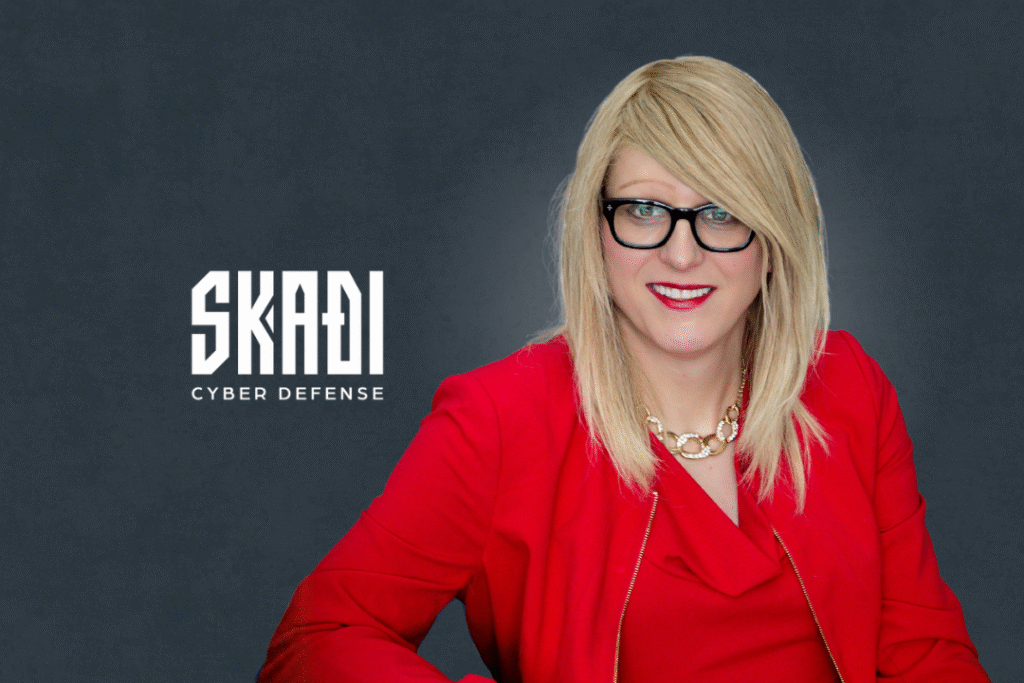
Rachel Clark is the CEO of SKADI Cyber Defense Corporation, which is now participating in the Catalyst’s Cyber Challenge go-to-market program. SKADI is an AI-driven autonomous security platform that operates at machine speed to protect businesses.
Learn more on their website: https://skadicyber.com/
- Where does your story begin? What made you want to build a cybersecurity solution?
I was on vacation in the Dominican Republic. For a very long time, I had been thinking about starting a business. Most of the time, I was thinking about what would actually be saleable and would solve a real problem — but I really didn’t have a good answer, because there were so many good cybersecurity solutions in the marketplace. I didn’t know how I could be a differentiator.
While on the beach, I read an article about a small business that lost everything in a ransomware attack. It made me unusually emotional: what would it feel like if I were them? The answer was always that I would be angry that there wasn’t more that could be done; and heartbroken that I didn’t do more.
Since I was working for a financial institution at the time, and I knew how great the bank was at cyber defense, my initial thought was about creating bank-level cyber-defense for the people who needed it but couldn’t afford it. That was the initial iteration of SKADI, which has gone through many pivots and changes during our 2+ years in business but has arrived at the same goal with which we started.
- Pitch your startup to us as if we’re someone who thinks cybercrime is “someone else’s problem.”
Cybercrime is, worldwide, a $12.2 trillion dollar problem. It is bigger than the GDP of every country in the world except the United States and China. It isn’t just that you may become a victim — which will happen if you are complacent — but that our society also needs to have the moral imagination to see the issue on a much bigger scale.
Cybercrime doesn’t live in isolation. It isn’t some kid in mom’s basement making a few extra bucks. It is a large-scale operation that funds even larger criminal activities, enabling racketeering and organized crime. It funds despot nation-states like North Korea, which use that money to build ballistic missiles, or Russia, who use it to finance its war in Ukraine. It enables human trafficking and contributes to drug smuggling, which kills countless innocent people.
That is what makes it everyone’s problem. If you care about the world and your place in it, then you must care about the effects of cybercrime. As cyber defenders, we must do better about educating people as well about the larger consequences, so that this question never needs to be asked in the first place.
- What’s the best question you’ve been asked about your startup, and what was your answer?
“How can you differentiate yourself in a very crowded cyber defense space?”
I feel very strongly that there are more businesses out there that need cybersecurity than companies that provide it. As such, the idea that cybersecurity is a “crowded space” is not entirely accurate. For me, it is a green field.
What makes SKADI different is we never compare ourselves against others. If we are going to solve this enormous cybercrime issue, we are going to need to work together. I am continually excited when I see other companies, even direct competitors, succeed. It means that they have a product which other people want, and if I am being honest about wanting to be an ardent defender against cybercrime, then I must be truly happy when an organization gets what they need to defend themselves better. Otherwise, I am not holding true to my values.
At SKADI, our moral compass always points north. It’s in our DNA: it is who we are as a company. Part of that is celebrating industry wins as if they were our own.
Maybe this isn’t traditional capitalistic behavior, but if building things we love to build, and celebrating people and organizations when they win — even if they aren’t our customers — is wrong, then I don’t want to be right. This is what disrupting looks like.
- What’s something your team is thinking about that people aren’t thinking enough about?
We think that the artificial intelligence that is currently being delivered isn’t really artificial intelligence. These systems don’t generate concepts, adjust those concepts over time, and learn about behaviors; they just follow statistical rules and patterns. They don’t have the ability to actually reason.
We built a production system that uses ontological AI — meaning it learns security concepts autonomously by understanding causal relationships, rather than correlations. When it observes behaviors across networks, it creates hierarchical concepts and refines them over time based on what it learns. This is how actual intelligence works: forming concepts, testing them, evolving them.
But here’s what people aren’t thinking about: ontological AI has applications far beyond cybersecurity. Any field where causal understanding matters more than pattern recognition — for example, medical diagnosis, scientific research, legal reasoning, and education — needs systems that can form and refine concepts autonomously.
We’re proving in production that this is possible. We’ve solved the foundational problem of building AI that actually reasons.
The societal benefits are enormous. Imagine medical AI that understands disease mechanisms rather than matching symptom patterns; or scientific AI that forms hypotheses rather than finding correlations. We’re positioned to own the ontological AI space because we’ve already built it and deployed it at scale.
- How is the Cyber Challenge helping you right now?
The introductions, and help with navigating spaces we haven’t been privy to prior, have been an enormous help for us in our business. As a matter of fact, I would have described us as a startup company before we started with the Cyber Challenge; now I see us as a scale-up company. Much of that has been through our experience with the Catalyst.
We’re excited about making true, long-lasting relationships with people who are invested in being a part of the SKADI story, who believe in doing things differently, and who want to be at the forefront of an AI revolution that few people — if anyone — are thinking about.
I really love how invested the Cyber Challenge team is in this, and how proud they are of the work they are doing with us. It’s sincere, and it comes across as believing in us and our success — and that is motivating for me as a founder to want to do more. It makes it a true partnership!