





Bio:
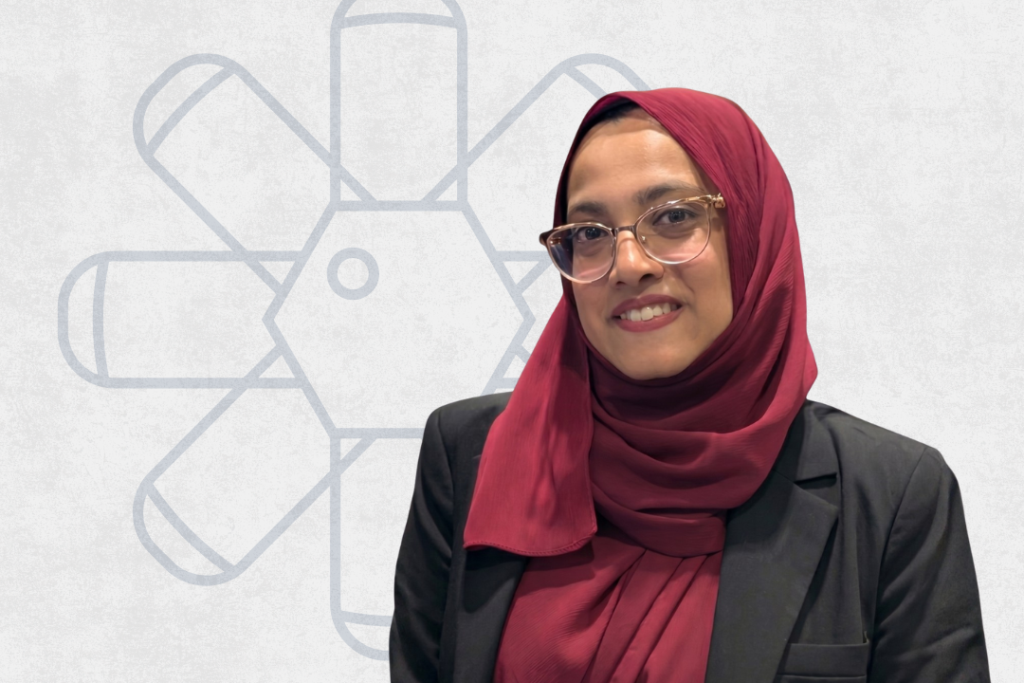
Aisha Khanam is a graduate of the Catalyst’s Accelerated Cybersecurity Training Program (ACTP). As a cybersecurity professional, her lifelong mission is to learn and grow, and she is always seeking out collaborative environments where diverse minds can thrive. Aisha believes in the power of data and human-centered approaches to solve complex challenges. As someone with ADHD, she understands the importance of neurodiversity and strives to create inclusive and supportive spaces.
Aisha Khanam learned early what it meant to take up space in rooms not built for her.
From studying engineering as the only woman among 67 men to building a platform that helps women enter cybersecurity with confidence, her career has been shaped by persistence, technical passion, and a belief in the power of women supporting women.
Aisha’s interest stemmed from cryptography, which she took up in Dubai. She was particularly fascinated by steganography (speech-in-speech) and completed her final year project on the topic. In one project, she encoded simple phrases — Hi Aisha, how are you? — into messages that could only be unlocked with the right decoder, revealing a hidden voice recording. Aisha felt she had found the area that she wanted to pursue.
After completing her studies in Dubai, Aisha had to move back home to Saudi Arabia. At the time, they didn’t offer jobs to women engineers.
There was no concept of women being in technical fields,” she says. She struggled, especially given her business-minded family and entrepreneurial spirit. When she came to Canada, Aisha said, “I thought, I’ll just get my foot in anywhere I can.
She made her start in a program called Npower. The program was for 18-29-year-olds, and she was 29. She was the most overqualified person in the class, but after completing the course, she started to interview. And after that, she got her first job, a role at Rogers Communications, but yet again, she was overqualified.
Her interviewer smiled apologetically at the routine question, “What is RAM?” The criteria for the role was way below her knowledge and skills, but she desperately needed the position. “Listen, I really need this job.” He hired her. And with her foot in the door, her passion for cybersecurity multiplied.
She enrolled in Cisco’s cybersecurity certificate. She was on scholarship at the time, and it was her first certification. She started applying for jobs. Crickets.
Out of the blue, Aisha got a call from a friend. She knew how passionate Aisha was about cybersecurity, and she had come across a program that seemed like the perfect fit. That program was the Catalyst’s ACTP.
Aisha didn’t even read through the whole description. She just applied.
I wasn’t expecting that program to change my life, my trajectory, but it was the last piece of the puzzle in my journey of cybersecurity that was missing. That was pretty much it.
Aisha applied with an eight-month-old baby and deferred the second cohort. When they met, they became part of an ongoing support group of bright, interconnected women cheering each other on in an industry where it was needed most.
A clerical error placed Aisha Khanam and Momna Farooq, co-founders of Marej, in the same (all-female cohort) of the Catalyst’s ACTP. Momna had applied to the second cohort, but in the chaos of the incoming pandemic, her application was lost.
After the program, Aisha transitioned from IT support and service desk to network and telecom security. She was on a team that utilized her degree but specialized in cybersecurity.
Still, old demons surfaced. The isolation and challenge of being a woman in a technical field were not new to her. While studying aviation engineering in Pakistan, she was the only woman among 67 men. In Dubai, there was mixed-gender representation, but there were moments during her internship that made her feel peripheral to the work she had trained for.
Today, she is the only single woman on her team. “There are about eight men,” she says. “When you’re working in a collaborative environment and sitting with one woman’s voice among so many men, unless you’re loud, you won’t be heard.”
Aisha says there was significant pushback and a steady effort to sideline her; her skills were undermined.
But things changed with one director. He sat Aisha down, and he asked her to help him understand the struggles of a woman in a male-dominated field.
Then, he began noticing patterns — who spoke, who was interrupted, whose ideas were overlooked. Her colleagues became aware. And there was a change. They had her back.
He told her plainly, “Push back. Be loud. Believe in your expertise.” Everything started to shift. “I brought you onto this team because you have every right to be here. You have to let them know very loudly that that is your right.”
Normally a soft-spoken person, Aisha began to practice. It’s a muscle, and each time she switches jobs or teams, she gives it some time, and then she starts back in…raising her voice.
She speaks of one general meeting in which she was the only security representative. And an individual who had no background in security said loudly to her, “Why do you want me to do it?”
“Because I’m wearing the security hat,” she said, “and I asked you to.”
The room went silent. “It’s a constant struggle,” she says.
Out of this experience came Marej — the organization Aisha and Momna co-founded, offering a direct, practical approach and the tools to find a role in cybersecurity.
If someone had given us these tools, we would have been so much more confident. It would have taken us so much less time to take up space.
She and Momna began coaching grads. But she had no clear sense of whether it was working. She couldn’t feel out whether she was making a difference. And then, back-to-back, three times, every person she referred got hired. “That was it, that was the moment for me. ‘Momna, I said, we’re making a difference.’”
They modeled the platform on their ongoing experience in their ACTP cohort. If any of them have a problem, they post it and ask for advice and expertise. Anyone who has input will offer up what they know, but if there isn’t offhand expertise, Aisha says, “We will hype each other up; you know, you’ve got this, you can learn this.”
“I wanted a platform where we could offer practical, hands-on knowledge to upcoming talent so they were confident enough to go into their roles.”
Her first female mentor inspired her in ways incomparable. She said, ‘You can reach out to me,’ and offered Aisha her cell phone number. “Anyone can say, ‘Add me on LinkedIn,’” Aisha reflects. “But it’s different when someone gives you direct access. That kind of support changes how you see yourself. I want to bring all that forward,” says Aisha.
Aisha feels we are still missing many women in leadership roles in cybersecurity. “It still remains a challenge for women to navigate through a male-dominant industry, or any industry at all; we see that.” But there is growing awareness, according to Aisha. There are women’s cohorts at the Catalyst. We see women on panels and women at cybersecurity events.
But I think when women support women, it creates a retention bridge, and that’s what we want.