







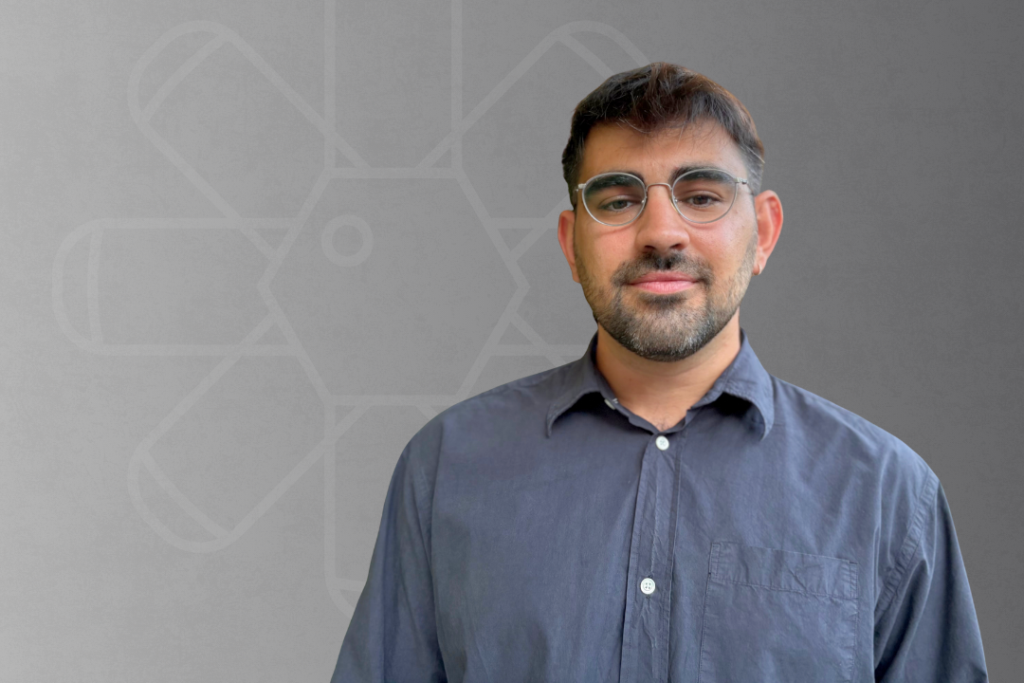
Liam Stock-Rabbat is an Industry Fellow in the Rogers Catalyst Fellowship and also Founder of Sanitized AI, a company helping organizations reduce human-driven security risks in the age of artificial intelligence. After more than five years leading security awareness and communications initiatives in his previous role at Ubisoft, Liam is focused on building AI security solutions that protect people where they work.
When artificial intelligence began reshaping the workplace, Liam Stock-Rabbat saw both enormous potential and a growing risk. As organizations rushed to adopt AI tools, employees were unknowingly sharing sensitive information with them. Liam decided to build a solution.
His interest in human behaviour and risk timed with the November 2015 attacks in Paris, while studying political science and social and economic history. Liam’s focus was on counter-radicalization, but in the course of his studies, he realized that the counter-terrorism industry would wane with a focus on emerging threats. He saw long-term potential in cybersecurity; as he transitioned into crisis and security management, his academic background provided a unique asset: a deep understanding of human behaviour.
As Liam developed in security, AI began to surge. He became interested in the possibilities offered by AI but was equally concerned about the risks. Recently, his observations led him to begin developing a tool, Sanitized AI: a browser extension that monitors what users type into AI tools. If a prompt contains sensitive information, the tool prevents users from sending it, explains why it is risky, and generates a version that removes the sensitive data.
“It was through my work in security awareness that I realized no one was doing that,” said Liam. “So, I thought, I’m going to start.”
The industry came with some fixed realities. For those with non-technical profiles, the go-to specialties were security awareness, business analysis, or project management roles within the security department. Liam wanted to explore opportunities beyond these typical fields, and entrepreneurship was an exciting avenue.
“You can’t keep growing,” he says. “The long-term optics are skewed compared to if you were in a technical role, where there are many avenues that you can pivot to.”
Despite those challenges, Liam believes his non-technical background became one of his greatest strengths. His studies gave him a foundation for translating complex ideas into simple terms that everyone can understand.
That’s a skill you get in the humanities.
That ability to connect research with real-world practice eventually led him to the Rogers Catalyst Fellowship.
He came to the Catalyst because he wanted to develop a maturity model for a security awareness program at the organization where he was employed. He was reading extensively at the time and realized that security awareness as a discipline is still relatively new.
“I wouldn’t say it’s older than 20 years,” he says.
That led him to explore whether more established disciplines could offer lessons for improving how organizations build behaviours. His research served as the foundation for his Industry Fellowship project.
He wanted to pursue his research project, and it fit within the Fellowship.
“I thought, ‘Wow, I can be supervised, I can have credibility when it comes to the end product, and make a little money in the process.’”
His research focused on a simple question: what are the factors that lead to a successful security awareness program?
Rather than looking solely at training and compliance, Liam wanted to understand how security becomes part of an organization’s culture and how one can best shape the environment that influences how people make decisions and adopt behaviours.
His research showed that behavioural change requires more than phishing simulations and awareness campaigns. Organizations need to create environments where secure behaviour becomes the easy choice.
Liam’s research at the Catalyst addresses the key factors and underlying mechanisms that contribute to the maturity and efficacy of security awareness programs in fostering secure organizational behaviour. The goal? Security awareness initiatives can move beyond compliance and toward sustained behavioural change.
Liam examines how various psychological, instructional design, and organizational drivers influence whether employers consistently make secure decisions in their daily work. Liam frames security awareness maturity as a product of interacting mechanisms and structures as opposed to the accumulation of tools or activities. His research questions allows cybersecurity professionals to better understand how well awareness programs achieve behavioural change.
It’s a holistic approach to both the person, their environment, and their workplace.
He translated those findings into a maturity assessment that allows practitioners to answer 25 questions in about 15 minutes to understand where their programs stand and where improvements are needed.
The research also reinforced an idea that carries into Sanitized AI – people are more likely to make secure decisions when technology helps them in the moment rather than simply telling them what not to do.
The fellowship not only strengthened Liam’s research, but also reinforced his startup’s potential.
His company focuses on setting guardrails for AI and protecting organizations from risks users often don’t see.
People don’t understand why it’s bad to put your personal information into a free AI software or why it’s dangerous to use the AI solution you prefer instead of the one your company paid for. There are concrete risks to your data confidentiality and data privacy, as well as to the business and its intellectual property.
By the end of the Fellowship, Liam realized his research still had significant potential.
“It could be a PhD project,” he says, “but I don’t wish to pursue one for now.”
Instead, he appreciated the opportunity to pursue meaningful research without stepping away from his career.
That was the cool thing about the Catalyst. I could wear a temporary PhD hat under the supervision of an actual professor and not have to commit to a five-year project with all kinds of academic constraints.
“I really loved it. It gave me the ability to keep working, but also take a dedicated moment to nerd out on this.”
Today, Liam continues to build Sanitized AI, applying the same research-driven approach to help organizations adopt artificial intelligence more securely. For him, the mission is straightforward: most people aren’t careless with sensitive data because they want to be — they simply don’t know the risk is there in the first place.