







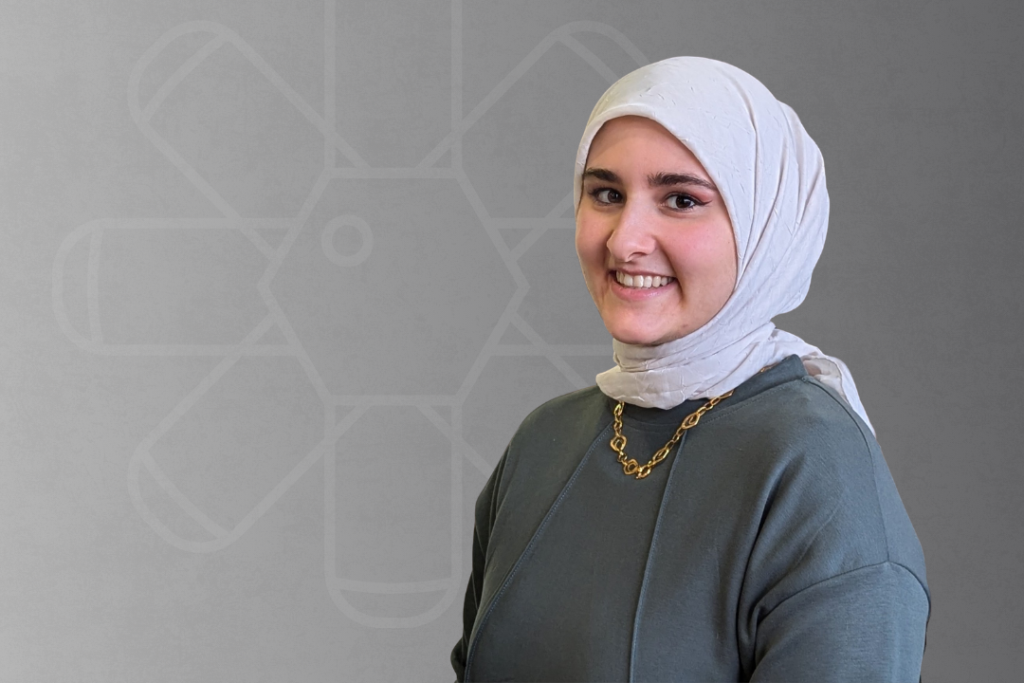
Tina Ismail is a Catalyst CyberStart Canada graduate and a cybersecurity analyst co-op student at RBC. Tina studied electrical engineering at McMaster University and was the chair of the IEEE Student Branch. Tina has attained her GFACT certification and received the ESET Canada Women in Cyber scholarship. She was recognized as a future leader by a member of parliament and the city of Markham.
I didn’t always feel there was a space for me in tech.
Though she comes from a family of engineers, she felt it wasn’t for her.
Growing up, Tina was interested in the arts. She was a top-performing student in her art classes in school, winning awards, and showcasing her work at her school’s annual Arts Night. She loved pushing the limits of her creative expression, from sculpture and wood carving to mixed media and illustration. She loves working with her hands, and after experimenting with woodshop in class, she bought herself a hand sander, table saw and various other tools to build a workshop at home. When she’s not pursuing artistic mediums, Tina enjoys reading, creative writing, and loves baking. She is currently endeavoring to study the chemistry of baking to make creations her family can’t resist.
Back in highschool, when she began planning a path forward, she decided to attend her first hackathon with her siblings. “It was one of those defining moments in my life. I looked around and thought, “Wow, everyone’s so into what they’re doing.” It was the start of something that snowballed. She decided to pursue engineering after that.
Her dad, an electrical engineer turned cybersecurity professional, has been an inspiration and a hero for her and has instilled in her a passion for learning. He would spend hours drawing diagrams on a whiteboard for Tina: “This is what a firewall does,” for instance. Following in his footsteps, she took to studying electrical engineering for the sake of learning, but was hesitant to pursue it professionally.
“The environment of electrical engineering is just a bit too restrictive for me. I felt I wouldn’t reach my potential. At the sites,” says Tina, “I would be working with men. I’m used to studying in a male dominated environment, but it’s never been a space where I feel 100% comfortable to be myself.”
It was at the BSides Toronto Conference that Tina made contact with the Catalyst. Although she knew about TryHackMe, she wasn’t active on the platform. But when the Catalyst’s CyberStart program popped into her inbox post-event, she thought she would give it a try.
Through working in cybersecurity, Tina is resolved to protect the public and those who have historically been disadvantaged. In AI, she reflects, there is a significant environmental and creative impact; people lose their intellectual property. She wants to protect the human brain, the one that is creative and uniquely produces the art she values so much.
“I really put my all into it,” says Tina. “And I continue to do so. I love the program, and I truly appreciate all the opportunities it’s opened up for me.”
With the program’s support, she completed her GFACT certification, which helped her find traction and has led her to excel in the field.
It’s honestly a dream come true. I’m really grateful for the program. I’ve found that I belong in cybersecurity now.