







This piece appeared in The Cambridge Times on October 8, 2026.
ASOS customers were reportedly sent threatening messages on their phones following a breach. Toronto cybersecurity expert, Randy Purse, shares how customers can protect themselves.
Canadian customers of the global fashion platform are among those potentially affected. ASOS says no payment card information or passwords were accessed.
Toronto cybersecurity expert Randy Purse, Senior Trainer and Practice Lead for the Rogers Cybersecure Catalyst at Toronto Metropolitan University (TMU) and part-time professor at TMU’s Master of Cybersecurity program, shares what customers need to do to protect themselves.
ASOS push notification: what the hackers’ threatening message said
ASOS customers reportedly received an alarming push notification sent to their phones on Tuesday by hackers claiming to have compromised the company’s systems.
The message appears to be addressed to ASOS’s DPO (Data Protection Officer) and its IT department.
The notification started off with “ASOS HACKED” before addressing the company’s technology teams.
“We have fully compromised the SnowFlake instance. Engage with us or we will leak it,” the notification said. The message also included a Telegram link directing the company to contact hackers through the encrypted messaging platform.
Telegram is a preferred tool for many cybercriminals commonly used to negotiate ransoms or communicate with victims.
Hackers claimed to have gained access by compromising the company’s SnowFlake account. SnowFlake is a cloud-based platform that provides data storage and processing and is used by many major online retailers worldwide.
Screenshots of the notification spread on social media with multiple customers claiming to have received the notification on their phones through the ASOS application.
ASOS confirms unauthorized access to customer data
In a statement sent to Metroland Media on Tuesday, ASOS shared an update regarding the cyber incident.
“We are investigating unauthorized activity involving third-party platforms that we use to communicate with customers,” the company said in the notice, adding they have restricted access to the notification platforms and are working with specialist advisers and the authorities to investigate the incident.
What ASOS told customers in its Oct. 8 update about the breach
In a notice sent to customers that the company shared with Metroland Media on Oct. 8, ASOS said its internal investigation has found that an unauthorized party gained access to an ASOS employee account by impersonating a trusted contact to obtain login credentials.
“Those credentials were then used to access information on certain third-party platforms used by ASOS,” the company explained, adding the affected platforms have already been locked down and full investigation will continue.
The company said the unauthorized party had access to some personal information, including names and contact details, and certain non-personal account related information.
ASOS said no payment card information and no account passwords were accessed.
“There is no action you need to take on your account,” ASOS told customers. However, the company said customers should remain cautious of unexpected messages or calls claiming to be from ASOS.
“We will never ask you to share passwords, security codes or payment details through an unsolicited message or call,” ASOS added.
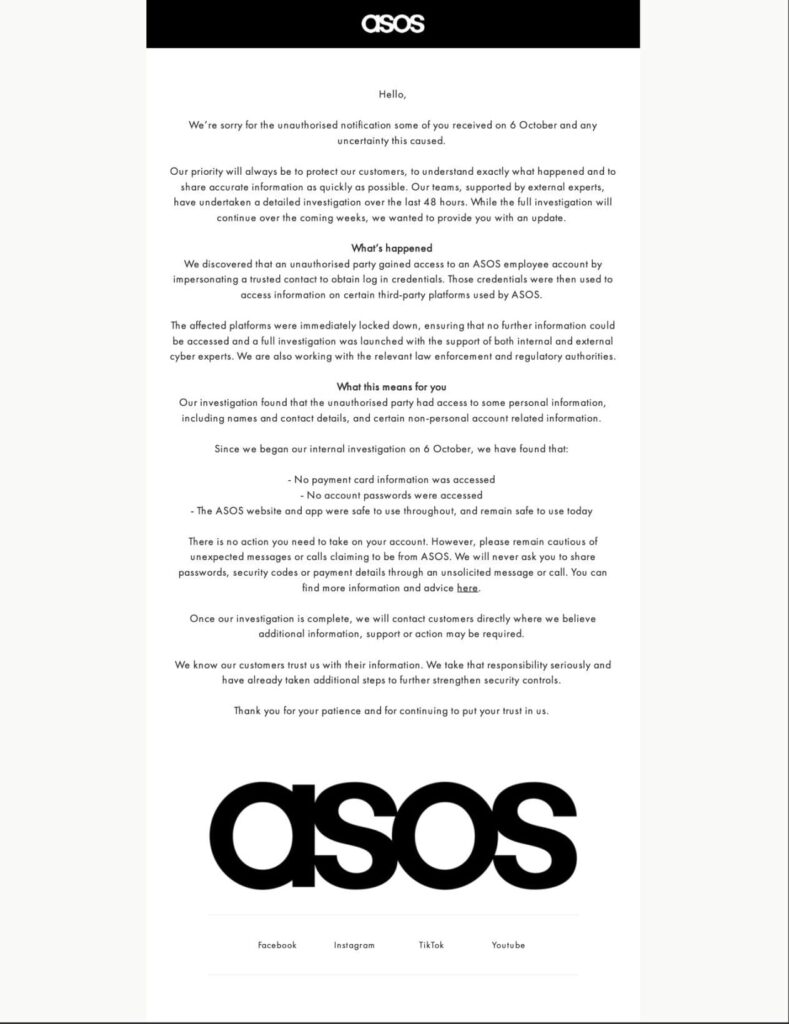
The official ASOS notification sent to customers with more details about the incident. The company said an ASOS employee account was compromised by hackers who impersonated a trusted contact.
ASOS
How to protect yourself after the ASOS data breach, according to a Toronto cybersecurity expert
Cybersecurity experts advise customers to take precautions to keep themselves and their data safe.
ASOS customers and, in fact, all users should be vigilant about their online activities,
Purse said. He recommends the following precautions that people should consider in light of the ASOS incident.
Be cautious about any correspondence around a cyber incident or breach
Cybercriminals may use the news about the breach to prey on people’s fears and leverage the incident to trick people into taking actions that may, on the surface, be legitimate, but actually compromise their security.
Hackers may use phishing emails or texts about the incident designed to exploit people’s fear.
“One example is where an email asks you to confirm your account information in support of the investigation. This is then used by the cybercriminals to get access to your accounts,” he added.
Avoid clicking on links or visiting unsecure websites
Do not click links from unsolicited emails or texts but be aware that even known organizations and people can be spoofed. An attack called URL spoofing may use similar characters to make a fake URL look very similar to a legitimate one. Experts always advise to check the source of the link or go to the organization’s site directly.
Ensure that your devices are protected and updated
Use strong, unique passwords, use multifactor authentication (MFA) wherever possible, and update devices and applications or software with the latest security patches.
As this event unfolds and more information becomes available, the primary thing is to not panic or take actions without considering whether or not the links are trustworthy or the information is coming from a credible source.