






This piece appeared in SMB AI Magazine on October 27, 2026.
In an exclusive interview with SMB AI Magazine, Katrina Lawrence, Practice Lead and Senior Trainer, AI at Rogers Cybersecure Catalyst, Toronto Metropolitan University, explores what it takes for organizations to adopt artificial intelligence with greater understanding, security, and accountability. Drawing from her work across AI education, cybersecurity, machine learning, and consulting, Katrina explains why AI literacy must extend beyond simply knowing how to use the latest tools.
Interview By Varun K Sirohi
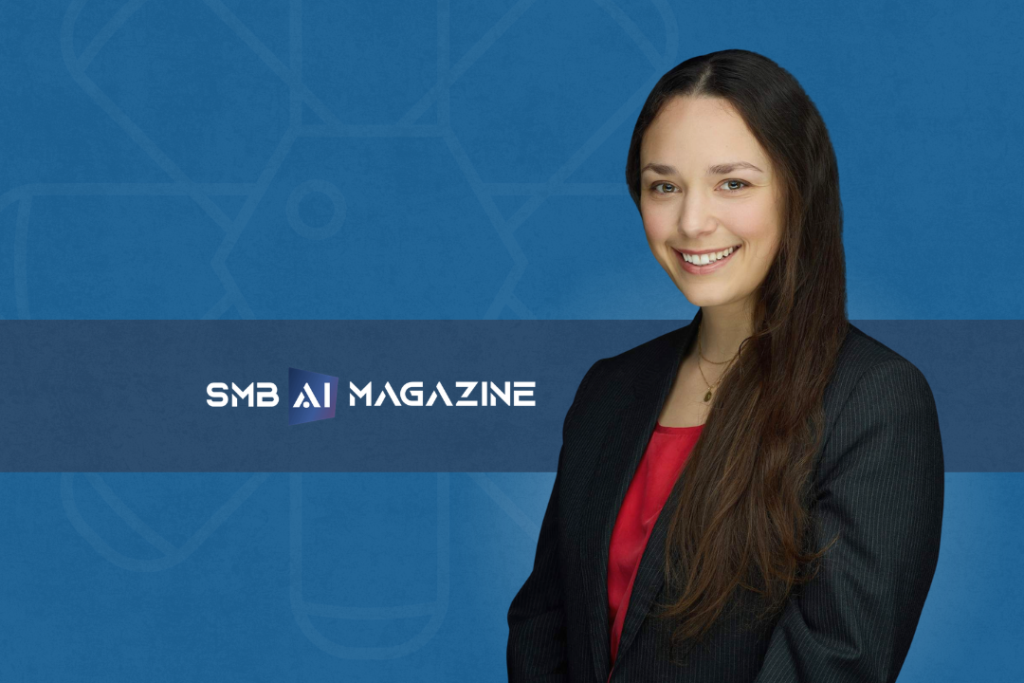
Katrina Lawrence is the Rogers Cybersecure Catalyst, Toronto Metropolitan University’s new Senior AI and Cybersecurity Advisor and Machine Learning Math Lead at Cohere Labs and adjunct professor at Eastern University where she teaches and designs graduate-level AI, machine learning, and mathematics courses. She additionally founded an AI consulting company “AI Unlocked With Katrina Inc.”, where she develops AI courses, and consults on AI implementation for organizations. She also focuses on machine learning mathematics education, and runs a math YouTube channel @MathUnlockedWithKatrina. In addition to her technical work, her debut novel, Beneath Enemy Skies, became an Amazon #1 bestseller in its category in 2025. Passionate about research and teaching, Katrina is committed to bridging the gap between cutting-edge AI advancements, and the learners, practitioners and innovators who will help shape the future.
There is also a misconception that if a tool is approved or considered “safe” today, it will remain safe indefinitely. Models and platforms are continuously updated, and their capabilities, integrations, and data and privacy practices can change. Tool evaluation therefore shouldn’t be a one-time exercise.
Finally, “AI safety” is often used as a catch-all term. We consider multiple dimensions, including data security, user protection, platform integrity, fairness and bias, accountability, harm reduction, and output integrity. Safe AI adoption requires organizations to think across these dimensions rather than focusing on a single risk.
Rogers Cybersecure Catalyst recently launched Secure AI, a course you co‑designed to help leaders understand AI risks and responsible adoption. For Canadian SMEs experimenting with AI tools today, what are the biggest misconceptions you see about “safe” AI use?
At the Catalyst, we work to empower individuals and organizations with the knowledge and skills to navigate evolving cybersecurity and AI challenges. Through programs such as our Secure AI courses, we work with learners across government, SMEs, large enterprises and academic institutions to build practical knowledge around secure and responsible AI adoption.
One of the biggest misconceptions I see is that an AI tool can be assessed for safety in isolation. Behind the interface is an AI model, and potentially third parties, APIs, cloud services and data providers. Risks can be introduced throughout this value chain, so organizations need to consider the security of the broader ecosystem.
There is also a misconception that if a tool is approved or considered “safe” today, it will remain safe indefinitely. Models and platforms are continuously updated, and their capabilities, integrations, and data and privacy practices can change. Tool evaluation therefore shouldn’t be a one-time exercise.
Finally, “AI safety” is often used as a catch-all term. We consider multiple dimensions, including data security, user protection, platform integrity, fairness and bias, accountability, harm reduction, and output integrity. Safe AI adoption requires organizations to think across these dimensions rather than focusing on a single risk.
Your consulting work through AI Unlocked With Katrina Inc. focuses on making AI approachable—from strategy and workshops for non‑technical teams to deep machine‑learning math for advanced learners. How do you design education so that both audiences—business leaders and technical practitioners—can speak a common language about AI capabilities and limits?
I’ve been an instructor for years, and one of the most important things I’ve learned is how to curate education for learners with very different backgrounds and technical abilities. With a mixed audience, I start by establishing a common foundation of knowledge that everyone can work from. The underlying concepts don’t necessarily change, but rather the depth and perspective through which we explore them does.
A big part of creating that common language is connecting technical concepts to their practical implications. A business leader doesn’t necessarily need to understand the mathematics behind a model, but they should understand enough about how it works to appreciate its capabilities, limitations and risks. At the same time, technical practitioners benefit from understanding why those limitations matter from a business, security or governance perspective. I try to build that bridge so both groups can have meaningful conversations and make decisions together.
Most importantly, I adapt my teaching in real time. As I engage with learners, I can identify where they need more support, where their curiosity lies and where we can dive deeper for maximum impact. My goal isn’t to remove the complexity from AI, but to make that complexity understandable at the level each learner needs.
In your Catalyst role, you emphasize that AI is both an opportunity and a security risk, especially when casual use is mistaken for expertise. What practical first steps should a small or mid‑sized organization take to build AI literacy and governance before rolling out AI broadly?
AI presents tremendous opportunities to streamline workflows, automate processes and drive innovation, but its use can also introduce new security and data risks. For SMEs, I recommend starting with a small, practical governance framework that employees can actually understand and follow, rather than hundreds of pages of technical policy.
A good first step is establishing approved AI tools that reflect employees’ needs and have been appropriately vetted. Alongside governance, employees need practical AI literacy training that explains not just what the rules are, but why they exist and how to recognize risk as new situations arise.
Even with an approved tool, I encourage employees to ask two questions every time they use AI: What data am I putting in? What am I doing with the output, and who will see it? The first addresses data security and privacy; the second encourages human oversight and responsible use. Organizations should also maintain appropriate visibility into how AI is being used.
Above all, using AI doesn’t transfer accountability. Employees remain responsible for validating what they create and how they use it. AI should enhance our workflows and create more time for strategic thinking, creativity and human interaction, not replace the judgment and authenticity we bring to our work.
You teach and design graduate‑level AI and machine‑learning mathematics courses, while also running a YouTube channel to unlock math for a wider audience. Why do you believe a stronger grasp of the underlying math changes how people build, evaluate, and trust AI systems?
This is something I’m very passionate about. My background is in applied mathematics, and I’ve always seen math as a key to unlocking the world around me. That philosophy is behind my YouTube channel, Math Unlocked with Katrina, where I provide free lessons to make mathematics more accessible. I want learners to understand math in a way that makes sense to them, and then have it in their toolkit to power whatever they choose to pursue.
Today, machine learning and AI are among the biggest applications of mathematics. A stronger grasp of the underlying math allows us to look past the looming “black box” and understand what makes the machine run. For those building AI, it helps explain how algorithms learn and models are optimized. For those evaluating AI, it helps identify meaningful limitations, parameters and evaluation metrics rather than simply trusting an output because it came from AI.
There is also a security dimension: understanding how data moves through a model and is transformed can help identify where vulnerabilities may arise.
That doesn’t mean everyone needs to become a mathematician overnight. Even a high-level understanding of the foundations provides tremendous insight, allowing us to question AI, understand its limitations and ultimately trust it more appropriately.
Balancing your roles—as an advisor at the Catalyst, ML Math Lead at Cohere Labs, founder of AI Unlocked, educator, and now a bestselling novelist—what motivates you to keep bridging cutting‑edge AI research with everyday learners and practitioners, and what final advice would you offer SMB leaders who feel “behind” on AI?
I believe strongly in education and lifelong learning. I’m driven by curiosity about how the world works and how new technologies are built, but equally by the desire to turn around and share that knowledge with others. That is really the foundation of my passion for teaching.
I also believe there is tremendous value in being both technical and creative. My novel, Beneath Enemy Skies, gave me a creative outlet through history and storytelling, which has always been an important balance to my technical work. I think bringing different ways of thinking together can lead to new ideas and innovation.
For SMB leaders who feel “behind” on AI, I would encourage a mindset shift: instead of asking, “How do we catch up?” ask, “What can we learn and implement today?”
I recommend approaching this from two directions. Start internally: define your goals and challenges, then explore where AI could genuinely help. But also look outward. Dedicate even one or two hours each week to reading AI news, following trusted resources and exploring new developments. You may discover a capability or use case you didn’t even know to look for. Stay grounded in your goals, but leave room for curiosity, you never know what gem you might find along the way.